Introduction
Vascular access is a critical part of hemodialysis because it provides the pathway through which blood leaves the patient’s body, passes through the dialysis circuit, and returns after treatment.
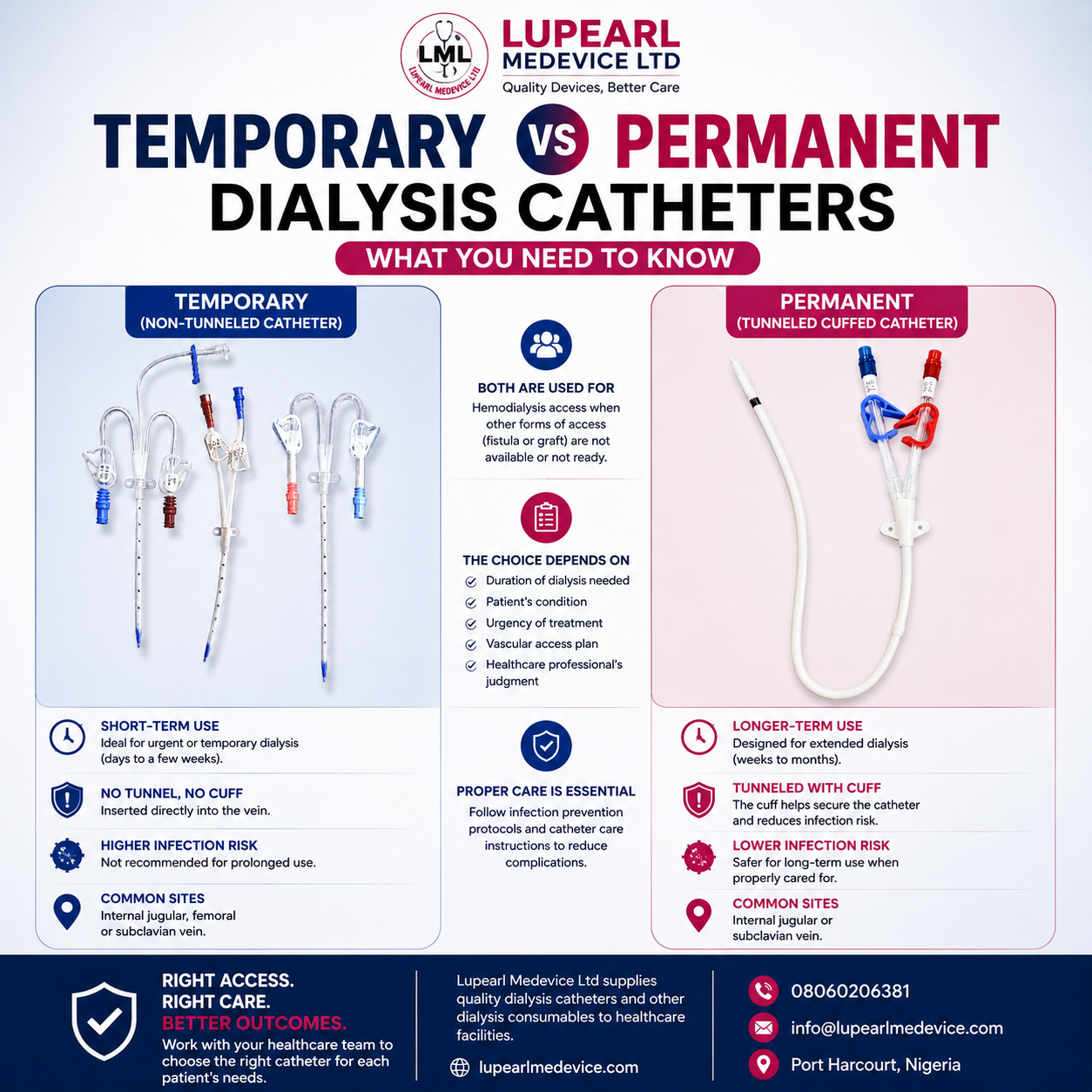
For patients who require catheter-based access, two broad categories are commonly encountered: non-tunneled temporary dialysis catheters and tunneled cuffed dialysis catheters.
Although both can provide access for hemodialysis, they are designed for different clinical situations and expected durations of use.
Understanding the difference can help dialysis professionals, healthcare facilities and patients better understand why one type of catheter may be selected over another.
What Is a Temporary Dialysis Catheter?
A temporary dialysis catheter generally refers to a non-tunneled, non-cuffed catheter intended for short-term vascular access.
These catheters can be particularly useful when dialysis needs to begin urgently and there is not enough time to establish or use another form of vascular access.
Situations may include:
- Acute kidney injury requiring urgent dialysis
- Emergency dialysis
- Critically ill patients
- Patients awaiting another vascular access option
- Situations where placement of a tunneled catheter is temporarily unsuitable
Current KDOQI guidance describes non-tunneled, non-cuffed catheters as serving a temporary role in acute situations where immediate hemodialysis is needed or where there are barriers to placing a tunneled cuffed catheter.
What Is a Tunneled Cuffed Dialysis Catheter?
A tunneled cuffed dialysis catheter is designed for longer-term catheter-based vascular access.
Unlike a non-tunneled catheter, part of the catheter is routed underneath the skin before entering the vein. A cuff is incorporated into the catheter and becomes surrounded by tissue, helping to stabilize the catheter and form a barrier along the tunneled pathway.
These catheters may be considered when:
- An AV fistula or graft has been created but is not yet ready for use
- A fistula or graft cannot be created or is not suitable
- A patient requires dialysis access for a longer period
- A longer-term catheter is clinically appropriate
The National Kidney Foundation notes that tunneled cuffed catheters may be used for periods longer than three weeks in situations such as when a fistula or graft is still maturing or when other permanent access options are unavailable.
Temporary vs Tunneled Cuffed Catheters
| Feature | Temporary Non-Tunneled Catheter | Tunneled Cuffed Catheter |
|---|---|---|
| Intended use | Short-term | Longer-term |
| Tunneling | No | Yes |
| Cuff | Generally absent | Present |
| Typical application | Urgent/acute dialysis | Longer-term catheter access |
| Placement | Usually relatively rapid | Requires a more involved placement procedure |
| Infection risk | Higher with prolonged use | Generally lower than non-tunneled catheters |
| Use while AV access matures | Sometimes | Commonly considered |
| Long-term suitability | Limited | Better suited when catheter access must continue |
The exact choice should always be based on the patient’s clinical circumstances and the healthcare team’s assessment.
Why Does Duration Matter?
One of the most important differences between these catheter types is how long they are expected to remain in place.
Non-tunneled catheters are intended for short-term situations. Prolonged use can increase the risk of complications, particularly infection.
KDOQI notes that cuffed tunneled catheters have a lower infection risk than non-tunneled catheters and recommends limiting the use of non-tunneled catheters.
UK Kidney Association guidance similarly recommends cuffed tunneled double-lumen catheters when temporary vascular access is expected to be needed for more than about three weeks, while non-cuffed catheters are used when access is expected to be required for a shorter period.
Why Are Tunneled Cuffed Catheters Used for Longer Periods?
A tunneled catheter provides several features that make it more appropriate when catheter-based access is needed beyond the immediate acute period.
The subcutaneous tunnel and cuff provide additional stabilization and help reduce infection risk compared with non-tunneled catheters.
They can also provide vascular access while a patient’s AV fistula or graft is developing.
However, a tunneled catheter is not automatically the best long-term access for every patient. When possible, an AV fistula or graft may be preferred because catheters carry important risks, including infection and thrombosis.
What Are the Risks Associated With Dialysis Catheters?
Like all forms of vascular access, dialysis catheters can develop complications.
Some important concerns include:
Infection
Catheter-related bloodstream infection is one of the major concerns associated with dialysis catheters. Catheters generally carry a higher infection risk than fistulas and grafts.
Thrombosis
Blood clots can develop within or around the catheter and interfere with blood flow.
Catheter Dysfunction
A catheter may develop poor blood flow because of issues such as malposition, kinking, thrombus or fibrin formation.
Central Venous Stenosis
Repeated or prolonged catheter use can contribute to narrowing or obstruction of central veins, which may affect future vascular access options.
Catheter Care Is Essential
Proper catheter care is an important part of reducing complications.
Healthcare professionals should follow appropriate infection-prevention procedures and the manufacturer’s instructions for use.
Patients with catheters should also be instructed to report concerning symptoms such as:
- Fever or chills
- Redness around the catheter site
- Swelling
- Pain
- Drainage
- Bleeding
- A loose or damaged dressing
- Changes in catheter function
The National Kidney Foundation recommends keeping the catheter dressing clean, dry and securely in place and reporting signs of infection or problems with the dressing to the dialysis team.
Which Catheter Is Better?
There isn’t one catheter that is universally better.
The appropriate choice depends on:
Urgency of dialysis → Expected duration → Patient anatomy → Access site → Clinical condition → Future vascular access plan → Healthcare professional’s judgment
For example, a critically ill patient requiring immediate dialysis may require a temporary catheter, while a patient whose AV fistula is still maturing may require a tunneled cuffed catheter during that period.
The goal is to provide appropriate vascular access while considering patient safety and preserving future access options.
Temporary Access Should Have a Plan
When a temporary dialysis catheter is inserted, it is important to consider what happens next.
If the patient is expected to require dialysis beyond the short-term period, the healthcare team may need to evaluate whether the catheter should be replaced with a tunneled catheter or whether another form of vascular access, such as an AV fistula or graft, is appropriate.
Early planning can help reduce unnecessary prolonged catheter use and support better vascular access management.
Final Thoughts
Temporary and tunneled cuffed dialysis catheters both have important roles in hemodialysis, but they are designed for different situations.
Temporary non-tunneled catheters are primarily useful when rapid or short-term access is required, particularly in acute situations.
Tunneled cuffed catheters are designed for longer-term catheter-based access and may be appropriate when an AV fistula or graft is not yet ready, cannot be created, or is otherwise unsuitable.
The choice should always be individualized and made by appropriately trained healthcare professionals based on the patient’s condition, expected duration of dialysis, vascular anatomy and overall treatment plan.
Need Reliable Dialysis Consumables?
Lupearl Medevice Ltd supplies quality dialysis consumables and provides professional support to healthcare facilities.
Whether you are sourcing dialysis catheters, dialyzers, bloodline sets, fistula needles, heparin and other dialysis consumables, our team can help you discuss your facility’s requirements.
Contact Lupearl Medevice Ltd today to discuss your dialysis consumable needs.
Website: lupearlmedevice.com
Email: info@lupearlmedevice.com
Phone/WhatsApp: 08060206381
This article is provided for general educational purposes and does not replace professional medical advice, clinical protocols, or the manufacturer’s instructions for use.