Introduction
Reliable vascular access is essential for effective hemodialysis. When a patient requires catheter-based vascular access, choosing an appropriate dialysis catheter is an important part of planning and delivering treatment.
Dialysis catheters are available in different types, sizes, lengths and configurations, and the most appropriate option depends on the patient’s clinical situation and the intended use.
This article explains some of the key factors healthcare professionals consider when selecting a dialysis catheter for hemodialysis.
What Is a Dialysis Catheter?
A dialysis catheter is a specialized vascular access device that provides a route for blood to leave the patient’s body, pass through the dialysis circuit, and return to the bloodstream.
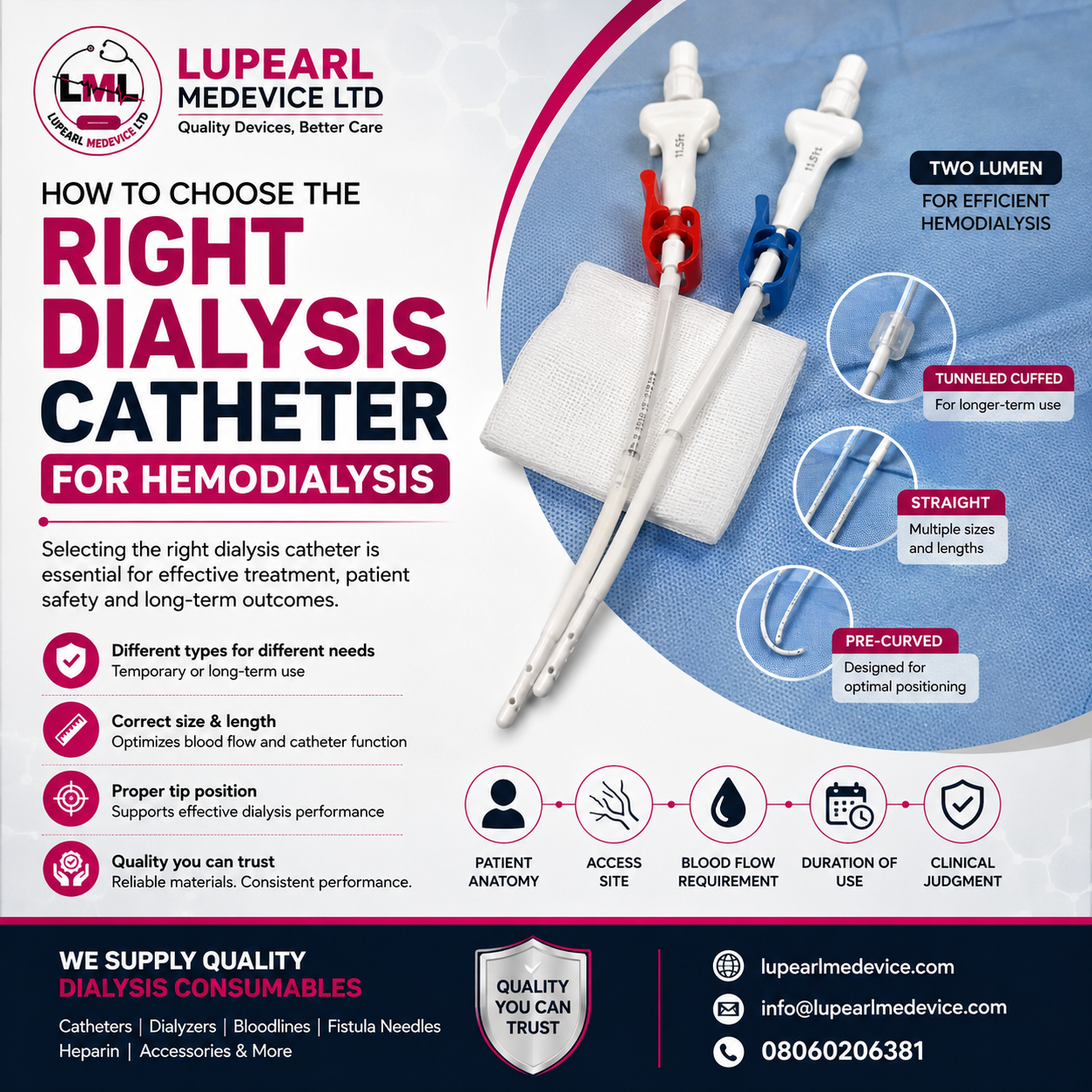
Most hemodialysis catheters have two lumens:
- Arterial lumen – draws blood from the patient to the dialysis machine.
- Venous lumen – returns filtered blood to the patient.
The catheter is connected to the extracorporeal blood circuit during treatment.
Types of Dialysis Catheters
One of the first considerations is the type of catheter required.
1. Non-Tunneled Dialysis Catheters
Non-tunneled catheters are generally used when vascular access is needed urgently or for a relatively short period.
They are commonly placed in settings such as:
- Acute kidney injury
- Emergency dialysis
- Intensive care
- Temporary vascular access while another access option is being arranged
Because they are intended for temporary use, their use should follow appropriate clinical protocols.
2. Tunneled Cuffed Dialysis Catheters
Tunneled cuffed catheters are designed for longer-term vascular access when an arteriovenous fistula or graft cannot be used or is not yet available.
The catheter is placed under the skin for part of its course, and a cuff helps with tissue integration and stabilization.
These catheters require appropriate placement, care and monitoring by qualified healthcare professionals.
How Do You Choose the Correct Catheter Size?
Catheter size is an important consideration because it can influence blood-flow performance and compatibility with the prescribed dialysis treatment.
Dialysis catheters are commonly specified in French (Fr) sizes.
For example, a catheter may be described as:
11.5 Fr × 20 cm
Here:
- 11.5 Fr refers to the catheter diameter.
- 20 cm refers to the catheter length.
The appropriate size should be determined according to the patient’s anatomy, vascular access site, prescribed treatment and the healthcare professional’s clinical judgment.
Why Catheter Length Matters
Catheter length is particularly important because different vascular access sites and patient anatomies require different catheter lengths.
A catheter that is too short may not provide adequate positioning, while an inappropriate length can affect catheter function or positioning.
Healthcare professionals therefore consider:
- The selected access site
- Patient anatomy
- Desired catheter tip position
- Patient size
- Catheter design
- Clinical circumstances
The catheter should always be selected and positioned according to appropriate clinical guidance and the manufacturer’s instructions.
Straight vs Pre-Curved Dialysis Catheters
Dialysis catheters can also differ in their physical configuration.
Straight Catheters
Straight catheters have a relatively direct configuration and are available in different lengths and sizes depending on their intended application.
Pre-Curved Catheters
Pre-curved catheters have a designed curvature that can facilitate positioning and routing in certain access situations.
The choice between a straight and pre-curved catheter depends on the access site, patient’s anatomy, clinician preference and the specific catheter design.
Blood Flow Requirements
A major consideration when selecting a dialysis catheter is the blood flow required for the prescribed treatment.
A catheter should be capable of supporting the required blood flow while maintaining appropriate function throughout the treatment.
Catheter performance can be affected by factors such as:
- Catheter design
- Internal lumen diameter
- Catheter tip configuration
- Position
- Vascular anatomy
- Blood-flow rate
- Patient movement
- Catheter-related complications
It is important to remember that a catheter’s advertised flow performance does not guarantee a particular blood flow in every patient. Actual performance depends on multiple clinical and technical factors.
Catheter Tip Position
Correct catheter tip positioning is an important part of achieving reliable catheter function.
The intended tip position depends on the catheter type and access site. Appropriate placement should be confirmed according to accepted clinical practice and applicable guidelines.
Poor positioning can contribute to problems such as:
- Reduced blood flow
- Increased pressure within the dialysis circuit
- Frequent alarms
- Poor dialysis adequacy
- Difficulty aspirating or returning blood
Catheter placement should therefore be performed by appropriately trained healthcare professionals.
Catheter Selection Should Be Patient-Specific
There is no single dialysis catheter that is ideal for every patient.
When selecting a catheter, healthcare professionals may consider:
Patient anatomy → Access site → Catheter type → Length → Diameter → Tip design → Prescribed blood flow → Expected duration of use
Taking these factors together can help support appropriate catheter selection.
Quality and Compatibility Matter
Dialysis centres should also consider the quality and specifications of the catheter before purchasing or using a product.
Important considerations may include:
- Sterility
- Catheter material
- Tip configuration
- Catheter dimensions
- Guidewire specifications
- Dilator and introducer components
- Tunneler, where applicable
- Packaging integrity
- Manufacturer instructions
- Regulatory requirements
- Compatibility with the intended clinical application
Healthcare facilities should obtain medical devices through appropriate and reliable supply channels and use them according to the manufacturer’s instructions.
Final Thoughts
Choosing the right dialysis catheter involves much more than simply selecting a size.
The catheter type, diameter, length, configuration, access site, tip position and required blood flow all need to be considered alongside the patient’s individual clinical circumstances.
Ultimately, catheter selection and placement should be determined by appropriately qualified healthcare professionals using established clinical protocols and the manufacturer’s instructions.
Need Reliable Dialysis Consumables?
Lupearl Medevice Ltd supplies quality dialysis consumables and provides professional support to healthcare facilities.
Whether you are sourcing dialysis catheters, dialyzers, bloodline sets, fistula needles, or other dialysis consumables, our team can help you discuss your facility’s requirements.
Contact Lupearl Medevice Ltd today to discuss your dialysis consumable needs.
Website: lupearlmedevice.com
Email: info@lupearlmedevice.com
Phone/WhatsApp: 08060206381
This article is for general educational purposes and does not replace professional medical advice, clinical protocols, or the manufacturer’s instructions for use.