Introduction
The dialyzer is one of the most important components of a hemodialysis treatment. Often referred to as the “artificial kidney,” it helps remove waste products and excess fluid from the patient’s blood when the kidneys are unable to perform these functions adequately.
Dialyzers are available in different types and specifications. One important distinction is whether a dialyzer is classified as low-flux or high-flux.
Although both are designed to perform the essential functions of hemodialysis, they differ mainly in the permeability of their membranes and their ability to remove certain substances from the blood.
Understanding this difference can help dialysis professionals make informed decisions about dialyzer selection based on the patient’s treatment requirements and clinical needs.
What Is a Dialyzer?
A dialyzer is a medical device used during hemodialysis to facilitate the exchange of substances between the patient’s blood and the dialysis fluid.
Inside the dialyzer are thousands of tiny hollow fibres. The patient’s blood flows through these fibres while dialysis fluid flows around them in the opposite direction.
A semi-permeable membrane separates the blood from the dialysis fluid.
Through processes including diffusion and ultrafiltration, unwanted substances and excess fluid can be removed from the blood while important components are retained.
What Is a Low-Flux Dialyzer?
A low-flux dialyzer has a membrane with relatively lower water permeability.
Its membrane is primarily designed to remove smaller molecules such as:
- Urea
- Creatinine
- Electrolytes and other small solutes
Low-flux dialyzers can provide effective clearance of small molecules and have historically been widely used in conventional hemodialysis.
However, their lower permeability means they are less effective at removing larger middle molecules compared with high-flux membranes.
What Is a High-Flux Dialyzer?
A high-flux dialyzer has a more permeable membrane that allows greater movement of water and facilitates the removal of a broader range of solutes, particularly some middle-molecular-weight substances.
In addition to removing small molecules such as urea, high-flux membranes can provide greater clearance of certain middle molecules, depending on the membrane characteristics and the dialysis treatment.
High-flux dialysis is commonly used in modern hemodialysis practice, with treatment selection depending on the patient’s clinical situation, dialysis prescription, equipment, and other factors.
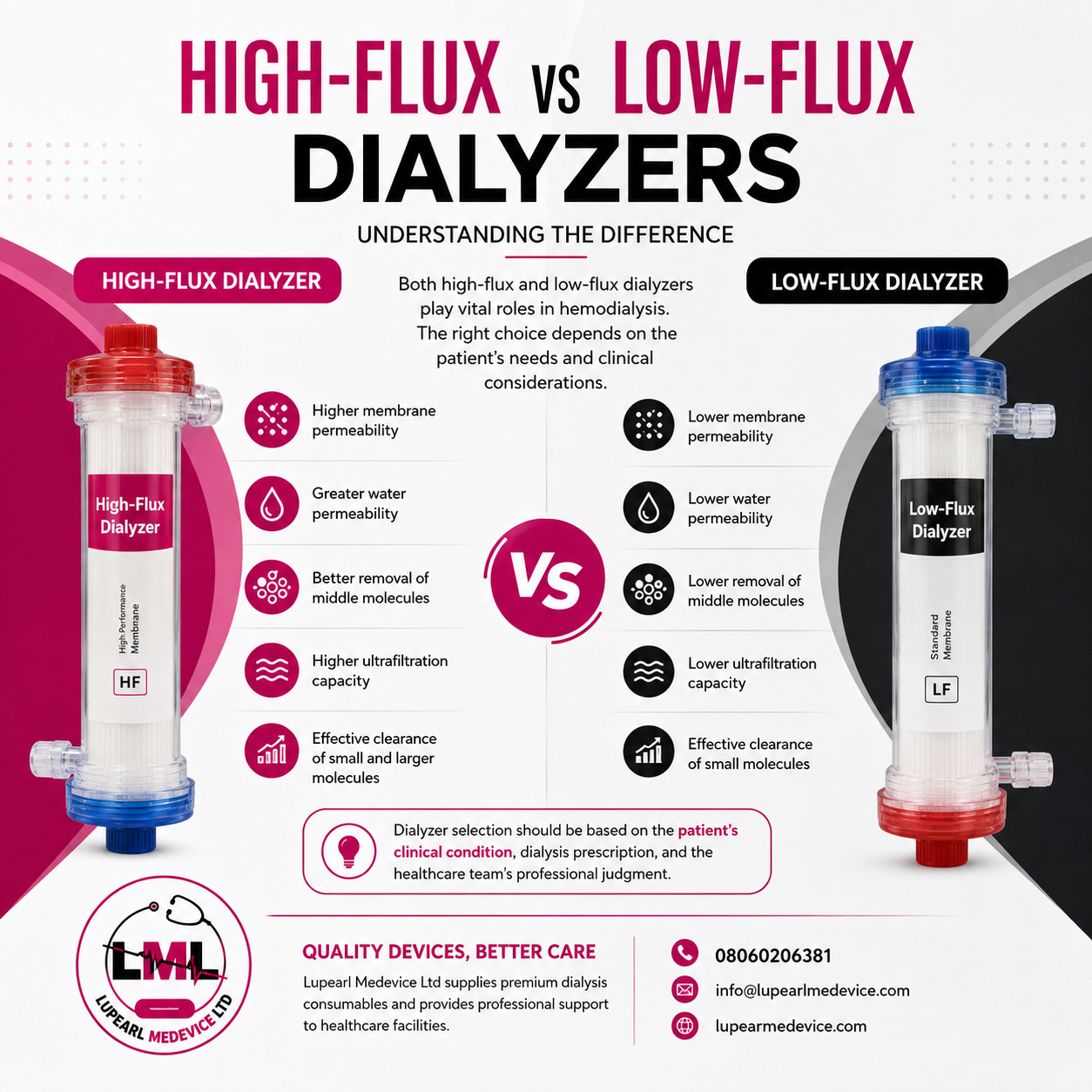
High-Flux vs Low-Flux Dialyzer: Key Differences
| Feature | Low-Flux Dialyzer | High-Flux Dialyzer |
|---|---|---|
| Membrane permeability | Lower | Higher |
| Water permeability | Lower | Higher |
| Small-molecule clearance | Effective | Effective |
| Middle-molecule clearance | Lower | Generally greater |
| Ultrafiltration capacity | Lower | Higher |
| Typical use | Conventional dialysis settings | Frequently used in contemporary dialysis practice |
The exact performance of a dialyzer depends on its membrane material, surface area, ultrafiltration coefficient, blood-flow rate, dialysate flow rate, treatment duration, and other specifications. Therefore, the terms “high-flux” and “low-flux” should not be considered the only factors when comparing dialyzers.
Why Does Flux Matter?
The main reason flux matters is that dialysis involves removing different types and sizes of substances from the blood.
Small molecules such as urea can cross dialysis membranes relatively easily. Some larger substances, often referred to as middle molecules, require a membrane with greater permeability for more effective removal.
This is one reason high-flux membranes can offer advantages in certain dialysis settings.
However, higher flux does not automatically mean that a dialyzer is better for every patient. Dialyzer selection should be based on the patient’s clinical requirements and the dialysis prescription determined by the appropriate healthcare professional.
Is High-Flux Always Better Than Low-Flux?
Not necessarily.
The appropriate dialyzer depends on several factors, including:
- Patient characteristics and clinical condition
- Dialysis prescription
- Vascular access and achievable blood flow
- Dialysis machine capabilities
- Treatment duration and frequency
- Dialyzer membrane characteristics
- Fluid-management requirements
- The healthcare team’s clinical judgment
A dialysis centre should therefore select dialyzers according to established clinical protocols and the requirements of the patients being treated.
What Should Dialysis Centres Consider When Choosing a Dialyzer?
Beyond simply choosing between high-flux and low-flux, dialysis professionals may consider several technical specifications.
1. Membrane Material
Different dialyzers use different membrane materials, which can influence their performance and compatibility.
2. Surface Area
The available membrane surface area can affect the dialyzer’s clearance performance.
3. Ultrafiltration Coefficient
This indicates the membrane’s water permeability and is an important consideration when managing fluid removal.
4. Clearance Specifications
Clearance values for different substances can help healthcare professionals understand the expected performance of a dialyzer under specified conditions.
5. Patient Requirements
The patient’s clinical condition and prescribed dialysis treatment remain central to selecting an appropriate dialyzer.
Final Thoughts
Both high-flux and low-flux dialyzers play important roles in hemodialysis. The major distinction is their membrane permeability and capacity for water and solute transport.
High-flux dialyzers generally provide greater permeability and can improve the removal of certain middle molecules, while low-flux dialyzers provide effective clearance of small molecules with lower membrane permeability.
Ultimately, dialyzer selection should not be based on the label “high-flux” or “low-flux” alone. Healthcare professionals should consider the patient’s needs, treatment prescription, machine compatibility, and the technical specifications of the individual dialyzer.
Need Reliable Dialysis Consumables?
Lupearl Medevice Ltd supplies quality dialysis consumables and provides professional support to healthcare facilities.
Whether you are sourcing dialyzers, dialysis catheters, bloodline sets, fistula needles, or other dialysis consumables, our team can help you identify products that meet your facility’s requirements.
Contact Lupearl Medevice Ltd today to discuss your dialysis consumable needs.
Website: lupearlmedevice.com
Email: info@lupearlmedevice.com
Phone/WhatsApp: 08060206381
This article is provided for general educational purposes and does not replace professional medical advice or the clinical judgment of a qualified healthcare professional.